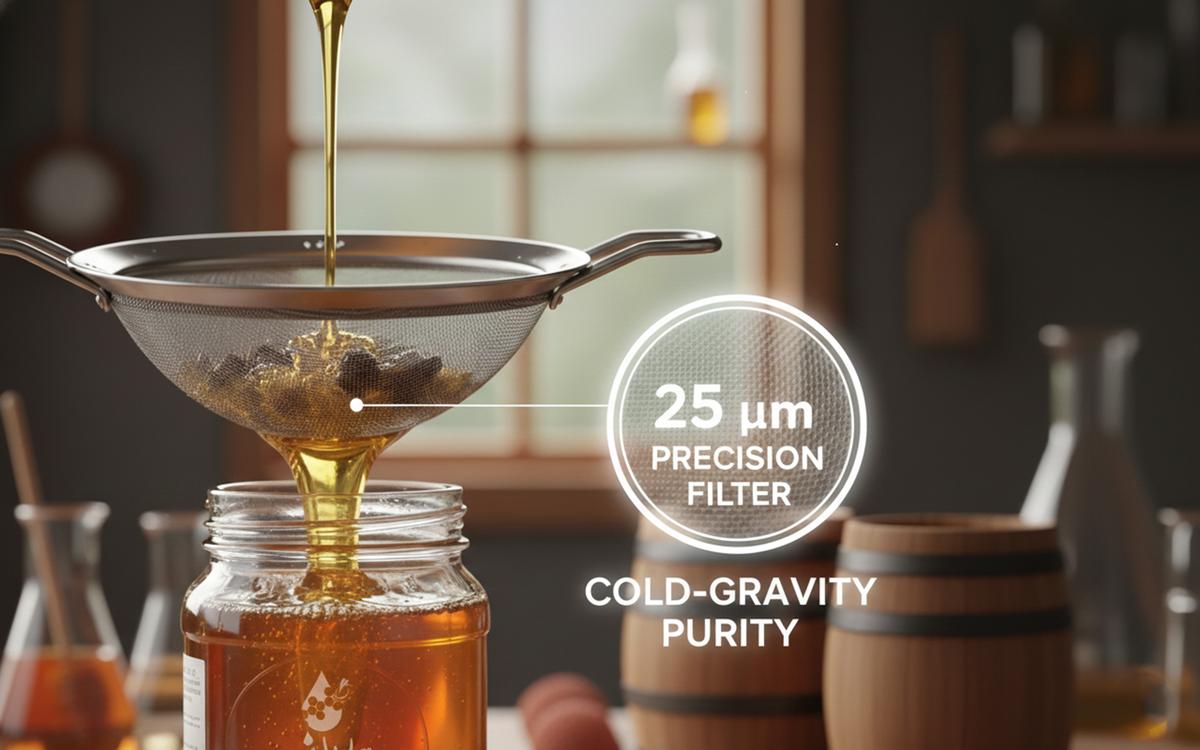
Why Our Cold-Gravity Filtration Protocol is an Act of Scientific Ethics
Walk into any store and you’ll be ambushed by jars shouting “Raw,” “Pure,” and “Natural.” But scratch beneath the label, and a startling truth emerges: most honey isn’t what it claims to be. The industry is drowning in buzzwords, and authenticity is on life support.
The global demand for natural sweetness is accelerating, and the industrial supply chain has responded with efficiency. This efficiency, however, comes at a cost: it fundamentally alters the chemical and biological identity of the honey itself. This is the great divide: on one side, a standardized, shelf-stable syrup; on the other, a living biological fluid—a true food, rich in active enzymes and volatile aromatics.
At HoniWow, our commitment to Lychee Honey is not just about taste; it is about reclaiming the integrity of the latter category. Our protocol—specifically, cold-gravity filtration through a 25-micron mesh—is a rigorous, scientific intervention designed to disrupt the status quo.
Part I: The Betrayal of Heat – Why Industrial Honey is a Dead Food
To appreciate our slow process, one must first understand the prevailing industrial shortcut: thermal processing and ultrafiltration.
The Double-Edged Sword of Heat
Raw honey, fresh from the hive, is naturally viscous (thick), especially at room temperature.
1. This viscosity makes bottling a slow, expensive process. Furthermore, the presence of glucose crystals and natural particulates causes the honey to crystallize, which consumers often mistake for spoilage.
The industry's solution? Flash-heating (pasteurization) to 70°C–80°C.
The Loss of Life (Enzymatic Denaturation): Honeybees enrich nectar with thermolabile enzymes like Diastase and Invertase—the very indicators of honey’s freshness and biological activity.
2. Heating to 70°C instantly deactivates them. You are left with sugar, not medicine.
The Marker of Damage (HMF Accumulation): Heat accelerates the conversion of honey’s sugars into 5-hydroxymethylfurfural (HMF).
3. While regulated, high HMF is the industry’s scarlet letter, signalling a definitive loss of nutritional integrity and imparting a "cooked" or burnt off-flavour.
The Stripping of Soul (Volatile Loss):
The delicate terpenes, aldehydes, and esters that make Lychee honey smell floral and fruity are highly volatile. Heating strips the honey of its signature "top notes," homogenizing its unique terroir into generic sweetness.
When HoniWow says "No heat, just slow filtration," we are rejecting this cascade of destruction. We accept a process that is 10 to 20 times slower because the science demands it.
Part II: Palynological Engineering – The Science of the 25-Micron Gate
Why 25 microns? Why not 100, or 10, or 0.1?
This precise figure is not arbitrary; it is the result of palynological engineering—the study of pollen grains.
The 25-micron threshold serves as a hyper-specific "molecular sieve," distinguishing between the nectar-source pollen that defines the honey’s character and the common environmental contaminants that cause visual turbidity and potential allergic reactions.
The Morphology of Lychee Pollen (The Good Stuff)
The Lychee tree (Litchi chinensis) is an entomophilous (insect-pollinated) species.4 Its pollen is designed to stick to the honeybee.
Scientific analysis confirms that Lychee pollen is structurally small: its critical dimension (Equatorial Diameter) consistently remains in the 16–20 micron range.
The Flow Advantage: Because the 25-micron aperture is geometrically larger than the widest part of the Lychee pollen grain, the grains easily align with the flow of the honey and pass through the filter. This ensures that the final product retains the essential proteinaceous and enzymatic profile derived directly from the Lychee blossom.
The Anemophilous Antagonists (The Bad Stuff)
Our Lychee orchards in West Bengal bloom during a tight, glorious window (Jan–Feb). This period often overlaps with the flowering of grasses and weeds (Poaceae). These pollens are anemophilous (wind-borne) and are the primary vectors for seasonal allergic rhinitis (hay fever).
Botanical Species | Pollen Diameter (μm) | Interaction with 25 μm Filter |
Lychee (Litchi chinensis) | 16 – 20 micron | PASS (Retained for Flavor/Enzymes) |
Bermuda Grass (Cynodon dactylon) | 28 – 30 micron | BLOCK (Allergen Removed) |
Timothy Grass (Phleum pratense) | 30 – 35 micron | BLOCK (Allergen Removed) |
The Exclusion Mechanism: The 25-micron mesh is a discriminatory barrier. It lets the Lychee DNA pass, but it mechanically sequesters the larger, allergenic grass and weed pollens.
This is the key to our unique value proposition: Hypoallergenic Raw Honey. We actively remove the accidental wind-borne contaminants that trigger sensitivities, delivering the full functional benefits of raw honey without the common allergic risk associated with standard "unfiltered" varieties.
Part III: The Physics of Patience – Cold-Gravity Rheology ⏳
The decision to process at ambient temperatures (20°C–30°C) is the single greatest operational constraint we face. This is where the human touch and dedication to "Slow Food" truly come into play.
The Cost of Cold
Honey viscosity (V) changes exponentially with temperature.1 This crucial relationship is defined by the Arrhenius equation, which clearly shows why heating honey makes it flow so much faster:
The Arrhenius Formula:
V = V_infinity e ^ (E_a / RT)
The honey’s viscosity (V) is the baseline viscosity (V_infinity) multiplied by the exponential factor (e) raised to the power of the activation energy (E_a) divided by the gas constant (R) times the temperature (T).
In simple terms: As the temperature (T) goes up, the viscosity drops dramatically.2
At 20°C (our operating temperature), honey’s viscosity is around 33.6 Pa·s.
At 70°C (industrial temperature), it drops to approximately 1.6 Pa·s.
We are handling a fluid that is 10 to 20 times thicker than what industrial packers process.
The Dictate of Darcy's Law
The rate of our filtration (Q) is governed by Darcy's Law, a principle of fluid flow. This law shows the direct, inverse relationship between flow and thickness:
Darcy's Law:
Q is proportional to 1 / V (Flow Rate is inversely proportional to Viscosity)
The practical meaning for HoniWow:
High Viscosity (V): Due to cold processing.
Low Pressure (Delta): We rely solely on the hydrostatic head of gravity.
Small Pore Size (25 micron ): High resistance.
The inescapable consequence is an extremely low flow rate (Q). Where an industrial plant processes tons an hour, we measure our output in dozens of litters. This is why HoniWow justifies a premium price point: you are paying for the time, dedication, and retention of biological integrity that speed would destroy.
Part IV: The Taste of Integrity – Preserving the Lychee Terroir
Our cold process ensures the Lychee honey remains a vibrant, functional food, not just a sweet treat.
The Active Benefits: Diastase & Glucose Oxidase
The preservation of Diastase and Invertase (sucrase) is paramount. They remain intact because our temperatures stay well below the 40°C threshold that begins to compromise their half-life. The preservation of Glucose Oxidase means the natural antibacterial activity of the honey remains potent. This biological matrix validates every health claim we make.
Locking in the Volatiles
Lychee honey is famous for its bright, floral, slightly rosy aroma—driven by molecules like Linalool and Cis-Rose Oxide. These compounds have high vapor pressures and would instantly evaporate if heated. Cold-gravity filtration operates as a closed loop for flavor; the aromatics remain dissolved in the honey, delivering the authentic terroir of the Indian Lychee orchard directly to your palate.
The HoniWow Promise: Patience is Our Ingredient
In a world that prizes speed and standardization, HoniWow offers a different measure of value: Patience.
We don't pump. We don't cook. We simply wait for gravity and the integrity of a 25-micron screen to separate the essential from the incidental. The result is a cleaner, purer, more bioactive Lychee honey that glows with the brilliance of the sun, delivering flavor and function that industrial processing simply cannot touch.
We do the hard work of waiting, so you don't have to compromise on the true taste and profound benefits of nature's perfect food.
Ready to taste the 25-micron difference?
(Click here to experience true, scientifically-backed, cold-filtered Lychee Honey)